The Bleed app is now available!


Regular cycle? You still need to track. Here's why.
I met a woman recently who told me she does not need to track her cycle because it is regular. She said it the way you would say something obvious. Like "I do not need to weigh myself, I already know my weight." Case closed.
I nodded politely. Then I went home and thought about how I only discovered I get insomnia two days before my period because I tracked it. Not one bad night. A pattern. A pattern I had lived with for years and never seen until I had the data in front of me. Once I saw it, I could plan for it. I stopped fighting those nights. I stopped assuming something else was wrong with me for that one week.
There are two reasons "regular" is not enough. One is what you would never notice without tracking. The other is what your doctor is about to start expecting.
"Regular" is fuzzier than you think
In the Apple Women's Health Study, 165,668 cycles from 12,608 women were tracked prospectively. Roughly 16 percent of women showed measurable cycle deviations. Another 25 percent self-reported irregular cycles. Translation: somewhere between one in six and one in four women who think they are regular are not, when you check with the data.
The recall problem is worse. A 2005 Journal of Women's Health study found that only 56 percent of healthy women could recall their last menstrual period accurately. Roughly one in five were more than two days off their own LMP from memory. Every clinical calculation your doctor makes downstream inherits that error.
Read that again. Your memory of your own cycle is not the same thing as your cycle.
What period tracking actually shows you
The obvious stuff is the cycle length and when the bleeding starts. That is the tip.
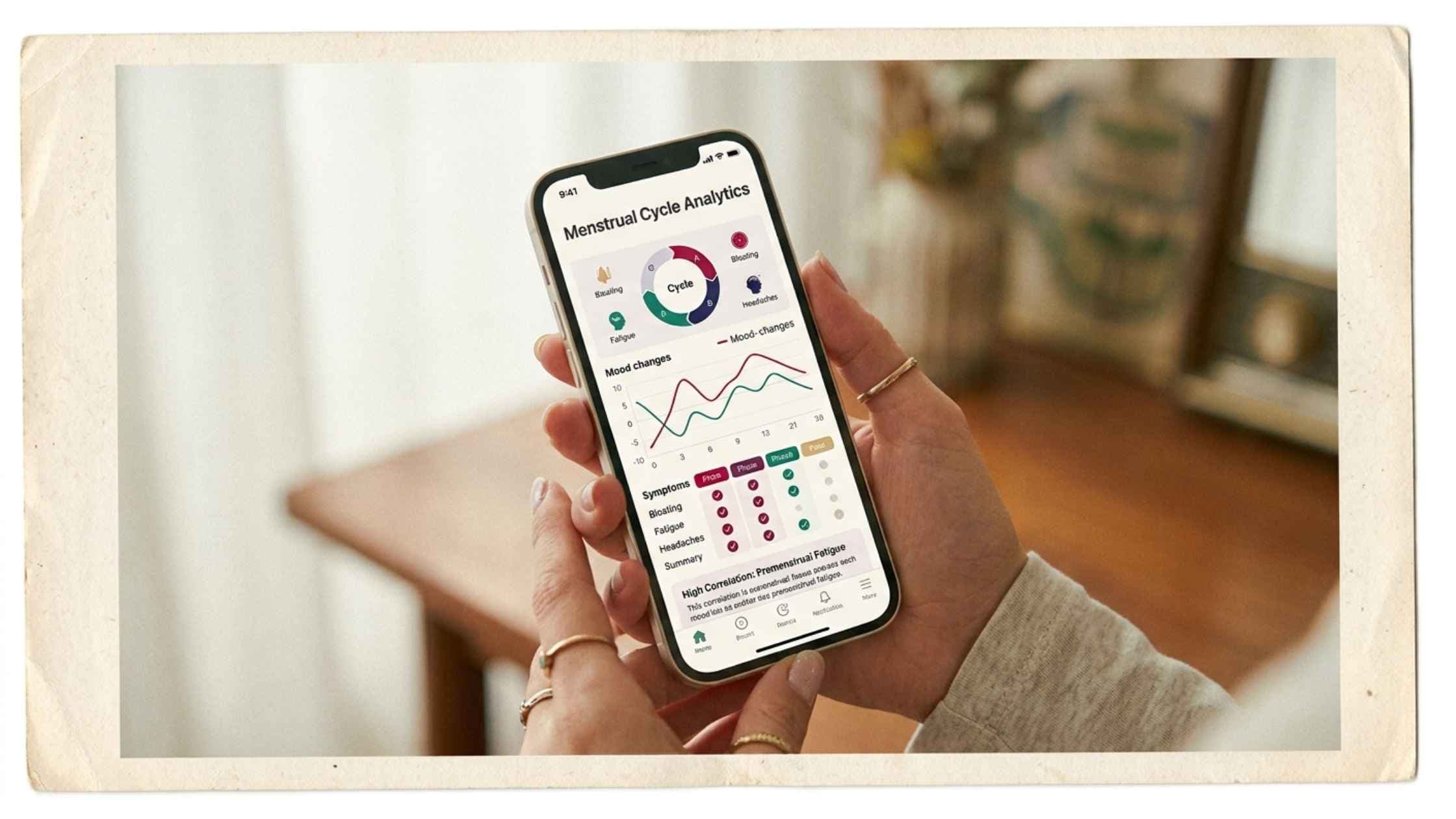
What tracking actually shows you is the pattern under the pattern. Sleep changes across the luteal phase (your body temperature rises about 0.4°C, which blunts normal nocturnal cooling, and you sleep worse on schedule). Mood shifts that cluster in specific days. Migraines that only happen in the two days before bleeding. Skin changes, energy dips, libido shifts, the days you can lift heavy and the days you cannot.
None of that shows up in your memory. All of it shows up in a log.
Some conditions cannot be diagnosed without a prospective log. PMDD requires two consecutive cycles of daily symptom ratings under DSM-5 criteria, using something called the Daily Record of Severity of Problems. Menstrual migraine diagnosis requires attacks on day −2 to +3 of menstruation in at least two of three cycles per the International Headache Society. PCOS diagnosis under the Rotterdam criteria depends on cycle length itself, specifically cycles longer than 35 days or fewer than nine bleeds in a year. All three are definitionally longitudinal. All three are invisible without a log. If you have not tracked, your doctor cannot diagnose you.
My "insomnia two days before period" is my personal pattern. I have not seen it in a study with those exact days for those exact reasons. But it is there, in my log, every month. I would never have known without the tracking.
The clinical future is coming
The NHS Women's Health Strategy for England was renewed in April 2026. Menstrual and gynaecological conditions are named a top priority. £25 million rolling out a women's health hub in every local area. New clinical pathways for heavy periods. A women's health module in the medical licensing assessment for every new doctor. Current endometriosis diagnostic delay in the UK is 9 years 4 months on average, and 11 years for women from diverse ethnic communities. Over 565,000 women are on the waiting list for gynae care.
Here is my read of that trajectory. Within five years, probably fewer, most clinician appointments will benefit from (and increasingly expect) six months of properly logged cycle data at intake. Not "I think it was around the 10th of last month." Real dates, real symptoms, real patterns you can hand over as a PDF or a screenshot.
This is my inference, not policy. Take it as one founder's read of where the wind is blowing.
ACOG has treated the menstrual cycle as a vital sign since 2015. That framing extended across the full reproductive lifespan in a Lancet article in 2025. The direction of travel is clear.
Just start
The catch is that patterns take three to six months to emerge. You cannot back-fill last year. The data begins the day you start.
That is not a small point. It is the reason I keep telling women who feel fine to open the app today. The version of you three months from now who has a question at a doctor's appointment cannot go back in time and start tracking. This you can.
I built Bleed so that starting takes ten seconds a day. Tap what you notice, close the app, get on with your life. No account, no email, nothing leaves your phone. If you want more from it, it gives you more. If you only ever log the day your period starts, that is a real dataset by month three.
The right test for whether to track is not "is my cycle regular." It is: if your doctor asked you today when your last three periods started, could you answer to the day, from memory?
If not, download something. Bleed if you want the version where the data stays on your phone. Another tracker if you don't. The point is to start now, so that by the time the answer matters, you have one.
Pass it on.
References
- Mahalingaiah S, Fruh V, Rodriguez E, et al. "Design and methods of the Apple Women's Health Study." npj Digital Medicine, 6 (2023). doi.org/10.1038/s41746-023-00848-1
- Wegienka G, Baird DD. "A comparison of recalled date of last menstrual period with prospectively recorded dates." Journal of Women's Health, 14(3) (2005). PMID: 15857271.
- American College of Obstetricians and Gynecologists. "Menstruation in girls and adolescents: using the menstrual cycle as a vital sign." Committee Opinion No. 651 (2015, reaffirmed 2021). Obstetrics & Gynecology, 126(6):e143–e146. doi.org/10.1097/AOG.0000000000001215
- Department of Health and Social Care (UK). "Women's voices to be at the heart of renewed health strategy." (April 2026). gov.uk
- American Psychiatric Association. Diagnostic and Statistical Manual of Mental Disorders, Fifth Edition. Premenstrual dysphoric disorder criteria (DSM-5).
- International Headache Society. International Classification of Headache Disorders, 3rd edition (ICHD-3). Menstrual migraine criteria. ichd-3.org
- Baker FC, Driver HS. "Circadian rhythms, sleep, and the menstrual cycle." Sleep Medicine, 8(6) (2007). doi.org/10.1016/j.sleep.2006.12.007
Found this useful? Send it to your group chat.